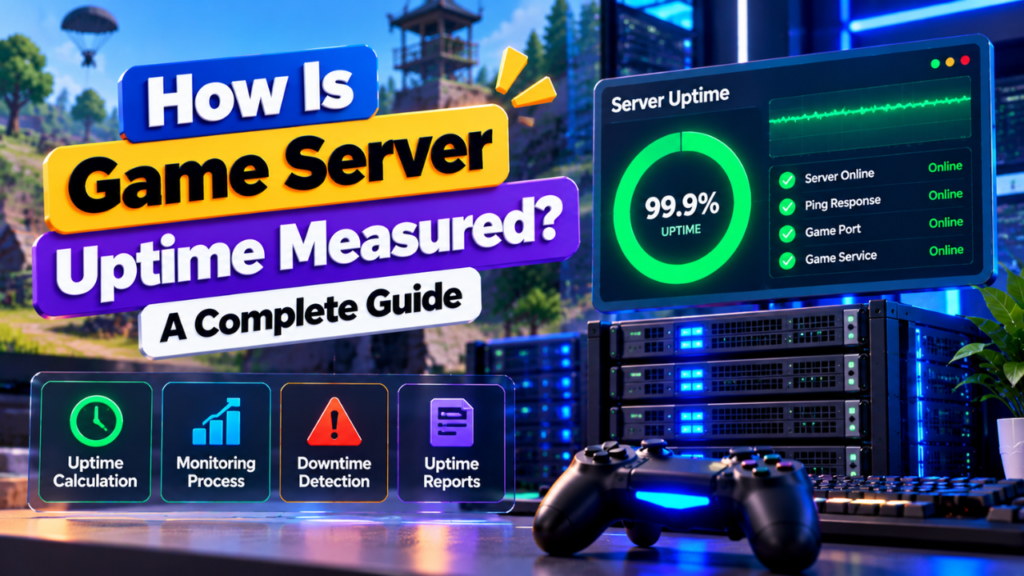
Game server uptime is measured by tracking whether a server remains online and accessible during a specific period. Monitoring systems regularly check the server and record successful and failed responses.
The collected data is then used to calculate the percentage of time the game server was available.
A simple uptime measurement process looks like this:
Server Check → Response → Status Recorded → Downtime Detected → Uptime Calculated
For game servers, measuring uptime is useful because a server can appear to be running while players are unable to connect. Good monitoring therefore looks beyond whether the machine is powered on.
How Is Game Server Uptime Calculated?
The basic uptime calculation compares the total monitoring period with the amount of recorded downtime.
The formula is:
Uptime % = (Total Time − Downtime) ÷ Total Time × 100
For example, assume a game server is monitored for 30 days and experiences 30 minutes of downtime.
Total time:
30 × 24 × 60 = 43,200 minutes
Available time:
43,200 − 30 = 43,170 minutes
Uptime:
43,170 ÷ 43,200 × 100 = 99.93%
The result is approximately 99.93% uptime.
The exact calculation can differ depending on the monitoring system and how the hosting provider defines downtime.
How Do Uptime Monitoring Systems Check a Game Server?
An uptime monitoring system periodically sends a check to the server or game service.
The monitoring system then records whether it receives the expected response.
A simplified process is:
Monitoring Service → Check Server → Receive Response → Record Result
If the server responds correctly, the check is normally recorded as successful.
If the expected response is not received, the system can record a failed check.
However, one failed check does not always mean the server is down. Temporary network problems can cause a single monitoring request to fail.
For this reason, monitoring systems may perform multiple checks before declaring an outage.
What Is Checked During Game Server Uptime Monitoring?
Different monitoring systems check different parts of a game server.
| Check Type | What It Measures |
| Ping Check | Whether the server responds to network requests |
| Port Check | Whether a specific port is reachable |
| TCP Check | Whether a TCP connection can be established |
| UDP Check | Whether supported UDP traffic can reach the service |
| Game Query | Whether the game service responds correctly |
| HTTP Check | Whether a web based service responds |
| Process Check | Whether the game server process is running |
| External Check | Whether the service is reachable from outside |
The best method depends on the game and how its server communicates.
Why Is a Ping Check Not Enough?
A basic ping test only tells you whether the server responds to that particular network request.
It does not necessarily prove that the game server itself is working correctly.
For example, the physical server may respond to network traffic while the game server process has crashed.
In this situation:
Server Online ≠ Game Service Available
A better monitoring setup checks the actual service or the relevant game server port when possible.
How Is Game Server Downtime Detected?
Downtime begins when monitoring checks indicate that the expected service is no longer available.
A monitoring system may use several failed checks before marking the server as down.
For example:
Check 1 → Failed
Check 2 → Failed
Check 3 → Failed
Server Marked Down → Alert Sent
The exact number of checks depends on the monitoring configuration.
This approach helps reduce false downtime alerts caused by short network interruptions.
How Is Downtime Recorded?
Once an outage is confirmed, the monitoring system records its start time.
When the server becomes available again, it records the recovery time.
For example:
| Event | Time |
| Server becomes unavailable | 10:15 AM |
| Outage detected | 10:16 AM |
| Server becomes available | 10:24 AM |
| Recorded downtime | 8 minutes |
The monitoring system can then include this downtime in the overall uptime calculation.
Some systems also maintain an incident history so you can see how often outages occurred and how long they lasted.
What Is the Difference Between Monitoring and Uptime?
Monitoring is the process of checking the server.
Uptime is the result calculated from those checks.
Think of it this way:
Monitoring → Collects Availability Data
Uptime Calculation → Converts Data Into a Percentage
Without reliable monitoring data, the reported uptime percentage may not accurately represent the server’s real availability.
How Is Uptime Measured From Different Locations?
External monitoring services can check a game server from different geographic locations.
This is useful because a server may be accessible from one network but unreachable from another due to routing or regional connectivity problems.
For example:
Location A → Server Reachable
Location B → Server Reachable
Location C → Connection Failed
This does not automatically mean the entire server is offline.
It may indicate a routing problem, regional network issue, or temporary connectivity failure.
Using multiple monitoring locations can therefore provide a better picture of real-world availability.
How Does Monitoring Frequency Affect Uptime Measurement?
Monitoring frequency determines how often the system checks the server.
For example:
| Check Frequency | Monitoring Behavior |
| Every 1 minute | More detailed outage detection |
| Every 5 minutes | Regular availability checks |
| Every 10 minutes | Less frequent monitoring |
| Every 30 minutes | May miss short outages |
More frequent checks can detect short outages more accurately, but monitoring systems may use different approaches depending on their purpose.
A short outage between two checks may not be recorded by a system that checks infrequently.
Therefore, the reported uptime can depend partly on the monitoring interval.
How Is Uptime Measured for an SLA?
Hosting providers may measure uptime according to the terms of their Service Level Agreement (SLA).
The provider’s SLA should explain:
- What counts as downtime
- How downtime is measured
- Which services are covered
- Whether scheduled maintenance is excluded
- How network outages are handled
- What compensation may apply
- How customers can submit claims
This is important because a provider’s advertised uptime percentage does not automatically mean every type of outage is included in the calculation.
Always check the actual SLA terms before comparing providers.
What Can Cause Differences in Uptime Measurements?
Two monitoring systems can report slightly different uptime percentages for the same server.
Common reasons include:
- Different monitoring locations
- Different check intervals
- Different downtime definitions
- Different failure thresholds
- Scheduled maintenance exclusions
- Network specific connectivity problems
- Temporary monitoring failures
For example, one system might detect a 2 minute outage while another system with a longer check interval might not record it.
This is why uptime percentages should always be considered together with the measurement methodology.
How Can You Measure Game Server Uptime Yourself?
You can measure uptime using an external monitoring service or your own monitoring system.
A basic setup requires:
- Choose the game server or service to monitor.
- Select the appropriate check method.
- Set the monitoring interval.
- Configure failure detection.
- Record successful and failed checks.
- Track downtime duration.
- Calculate the uptime percentage.
- Review outage history.
For important public servers, external monitoring is useful because the monitoring system remains separate from the game server.
If the game server completely goes offline, an external system can still record the outage.
What Is the Best Way to Measure Game Server Uptime?
There is no single monitoring method that works perfectly for every game server.
A better approach is to monitor multiple layers when supported:
Network Reachability → Game Port → Game Service → Player Availability
This provides more useful information than checking only whether the physical server responds.
For example, a server might be reachable at the network level while its game process is unavailable.
A layered monitoring approach can help identify exactly where the problem occurred.
Game Server Uptime Measurement Example
Suppose a game server is monitored for 30 days.
During that period:
- Total monitoring time: 43,200 minutes
- Confirmed downtime: 45 minutes
The calculation would be:
Uptime = (43,200 − 45) ÷ 43,200 × 100
Uptime = 99.90%
The monitoring system can then report approximately 99.90% uptime for that measurement period.
If there were several separate outages, their durations would normally be added together before calculating the final percentage.
FAQs
How is game server uptime measured?
Game server uptime is measured by regularly checking the server or game service and recording successful and failed checks. The data is then used to calculate the availability percentage.
Is ping enough to measure game server uptime?
No. Ping can show basic network reachability, but it does not always confirm that the actual game server process is working.
How often should a game server be checked?
The appropriate interval depends on the server and monitoring requirements. More frequent checks can provide faster and more detailed outage detection.
Can uptime monitoring detect short outages?
It can, but detection depends on the monitoring interval and failure detection settings. A short outage may be missed by an infrequently checked server.
Why do two uptime services show different percentages?
They may use different monitoring locations, check intervals, failure thresholds, and downtime definitions.
Does game server uptime include planned maintenance?
It depends on the monitoring system or hosting provider’s SLA. Some providers exclude scheduled maintenance from their uptime calculation.
Can I monitor game server uptime from outside the server?
Yes. External monitoring services can check the server independently and record availability even when the game server itself is offline.
Conclusion
Game server uptime is measured by continuously or periodically checking whether the server and its game service remain available. Monitoring systems record successful responses, failed checks, outage durations, and recovery times.
The collected information is then used to calculate an uptime percentage based on the total monitoring period and confirmed downtime.
For more accurate results, monitor more than basic network connectivity. Checking the relevant game service or port can provide a better indication of whether players can actually connect.
When comparing uptime figures, also consider the monitoring frequency, monitoring locations, downtime definitions, and SLA terms. This gives you a more realistic picture of a game server’s actual availability.