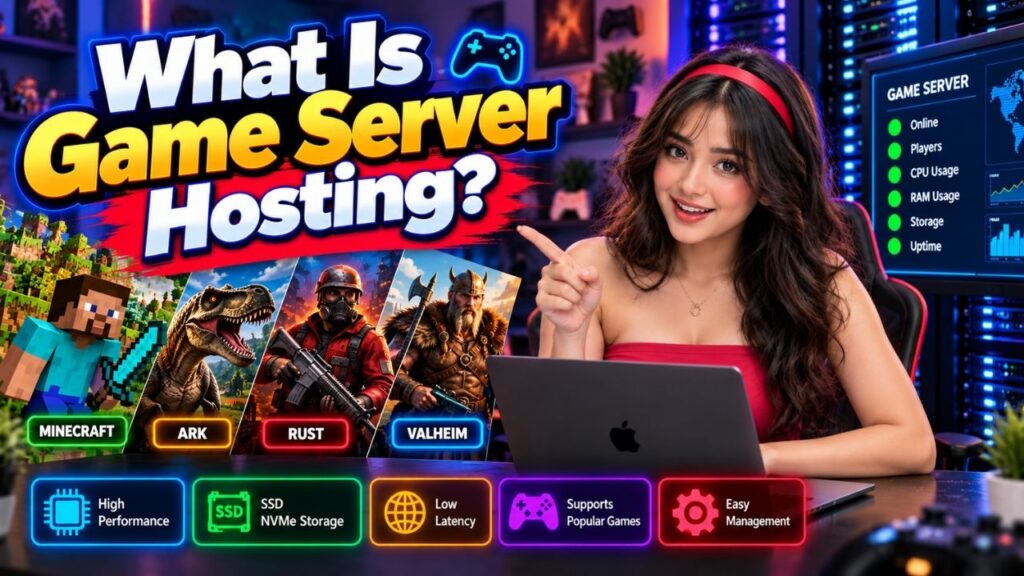
Playing a multiplayer game with friends is easy when everyone joins the same online session. But behind that session, there is a server handling the shared game world, player connections, and game data.
Game server hosting is a service that provides the infrastructure needed to run a game server online. Instead of using your own computer to host the server, you run the game server software on a remote machine provided by a hosting company.
This setup is commonly used for games such as Minecraft, ARK: Survival Evolved, Rust, Valheim, and other multiplayer titles that support dedicated or privately hosted servers.
Table of Contents
What Is Game Server Hosting?
Game server hosting gives you access to a remote server where the required game server software can run.
The server stays connected to the internet so players can connect to the game according to the title’s multiplayer system. The server can manage the shared game world, process player actions, save game data, and communicate with connected players.
Think of it this way:
Game server = the software that runs the multiplayer game environment.
Game server hosting = the infrastructure and service used to run that software online.
For example, when you create a Minecraft server for your friends, the server needs to run Minecraft’s server software and keep the world available. With game server hosting, that server runs on a remote hosting machine instead of your personal computer.
The exact technology differs from one game to another, but the basic purpose remains the same: provide a server environment where the multiplayer game can run and players can connect.
How Does Game Server Hosting Work?
The process is fairly simple from a player’s perspective.
A hosting provider allocates server resources for your game. You install or select the supported game server software, configure the server, and start it.
When players join, their game clients connect to the hosted server through the internet.
The basic flow looks like this:
Player → Internet → Game Server → Shared Game State → Players
The server processes the information it receives and communicates the relevant game state back to connected players. In a client server architecture, the server can act as the authoritative source for the shared game state, depending on how the particular game is designed.
This is why the server’s hardware and network connection matter. A server running a demanding game with many players has more work to handle than a small private server with only a few players.
What Does Game Server Hosting Include?
The exact features depend on the hosting provider and the game, but a game hosting plan generally provides the resources needed to run the server.
CPU
The CPU handles server side processing and game logic. The amount of processing power required depends on the game, number of players, mods, plugins, and workload.
RAM
RAM gives the game server working memory while it is running. Different games have different memory requirements, and modded servers can require more RAM than basic installations.
Storage
Storage contains the game server files and other data such as:
- Saved worlds
- Configuration files
- Mods and plugins
- Logs
- Backups
- Game related files
Many modern hosting services use SSD or NVMe storage, although the actual storage requirement depends on the game and server setup.
Network Connection
A game server needs a reliable internet connection so players can communicate with it.
The server’s location also matters because the physical and network distance between players and the server can influence latency.
Server Software
The hosting environment needs to support the server software required by your game.
Some games provide official dedicated server software, while others have different server options. Always check the game’s hosting requirements before choosing a plan.
Management Tools
Game hosting providers may also provide a control panel or other management tools.
Depending on the service, you may be able to:
- Start or stop the server
- Change server settings
- Manage files
- View the server console
- Install supported mods or plugins
- Create backups
- Restart the server
These features vary between providers, so they should not be assumed to be included with every plan.
Why Use Game Server Hosting?
The biggest advantage is that your personal computer does not have to act as the game server.
When you host a server at home, your own hardware and internet connection are responsible for keeping the server available. With game server hosting, those responsibilities move to the hosting infrastructure.
This can be useful when you want:
- A multiplayer server that is separate from your gaming PC
- A shared world for friends
- A server for a gaming community or clan
- Support for a modded game environment
- Easier server management
- A server that can remain available without your gaming PC running
For communities, this separation can be particularly useful because players do not have to wait for one person’s computer to become available before joining the server.
Game Server Hosting vs Home Hosting
You can host some games from your own computer, provided the game supports self hosting and your hardware and network are suitable.
With home hosting, your computer runs the game server. You are responsible for the hardware, electricity, operating system, network connection, updates, configuration, and general maintenance.
With game server hosting, the server runs on infrastructure supplied by a hosting provider.
| Game Server Hosting | Home Hosting |
| Runs on remote server infrastructure | Runs on your own computer |
| Provider supplies the server hardware | You provide the hardware |
| Designed for remote player connections | Depends on your home network |
| Hosting tools may be included | You manage the setup yourself |
| Can be separate from your gaming PC | Uses your own PC resources |
Home hosting can work well for a small private setup when you already have suitable hardware and understand the required configuration.
Game server hosting is mainly about moving that server workload to remote infrastructure so you do not have to maintain the hosting machine yourself.
Who Uses Game Server Hosting?
Game server hosting is not limited to large gaming communities. Different types of players can use it depending on the game.
Friends and small groups can use a private server for regular multiplayer sessions.
Gaming communities and clans can use a persistent server where members can play without depending on one player’s computer.
Modded-game communities can use hosting when the provider supports the required mods, plugins, or server software.
Streamers and content creators can also use private servers for community events, multiplayer sessions, or controlled gaming environments.
The resources required will depend on the game and how the server is used.
Is Game Server Hosting the Same as a Game Server?
No. The two terms are related but mean different things.
A game server is the software and running environment responsible for the multiplayer game session.
Game server hosting is the infrastructure and service that allows that server software to run online.
A simple example is a Minecraft server. The Minecraft server software runs the game world, while the hosting service provides the machine, storage, network connection, and other infrastructure needed to keep that server running.
Understanding this difference makes it easier to compare game hosting plans later because you are essentially choosing the infrastructure on which your game server will operate.
FAQs
What is game server hosting in simple words?
Game server hosting is a service that lets you run a multiplayer game server on a remote machine connected to the internet instead of hosting it directly on your own PC.
Do I need game server hosting to play multiplayer games?
No. Not every multiplayer game requires you to rent a game server. Many games use their own online infrastructure, while others allow players to host or rent dedicated servers.
Can I host a game server on my own PC?
Yes, if the game supports self-hosting and your computer, internet connection, and network configuration meet its requirements.
Does game server hosting keep my server online?
A hosted server can remain available independently of your personal gaming PC, but actual availability depends on the hosting service, maintenance, server configuration, and other factors.
Does server location matter for gaming?
Yes. The distance and network path between players and the game server can affect latency. A server that is geographically and network-wise closer to players may provide a shorter connection path.
Can I use mods with game server hosting?
That depends on the game and hosting provider. Some games support mods and plugins, while others have restrictions. The server software and hosting plan must support the modifications you want to use.
Conclusion
Game server hosting is simply a way to run a multiplayer game server on remote infrastructure instead of using your own computer as the host.
The hosting provider supplies the underlying server resources and network connection, while the game server software runs the actual multiplayer environment.
For friends, gaming communities, clans, modded servers, and other multiplayer setups, this can provide a practical way to keep the game server separate from personal gaming hardware.
Before choosing a service, the most important thing is to check whether it supports your specific game and provides the CPU, RAM, storage, network location, server software, and management features that your setup requires.
Pingback: Why Game Servers Need DDoS Protection for Safe Gaming