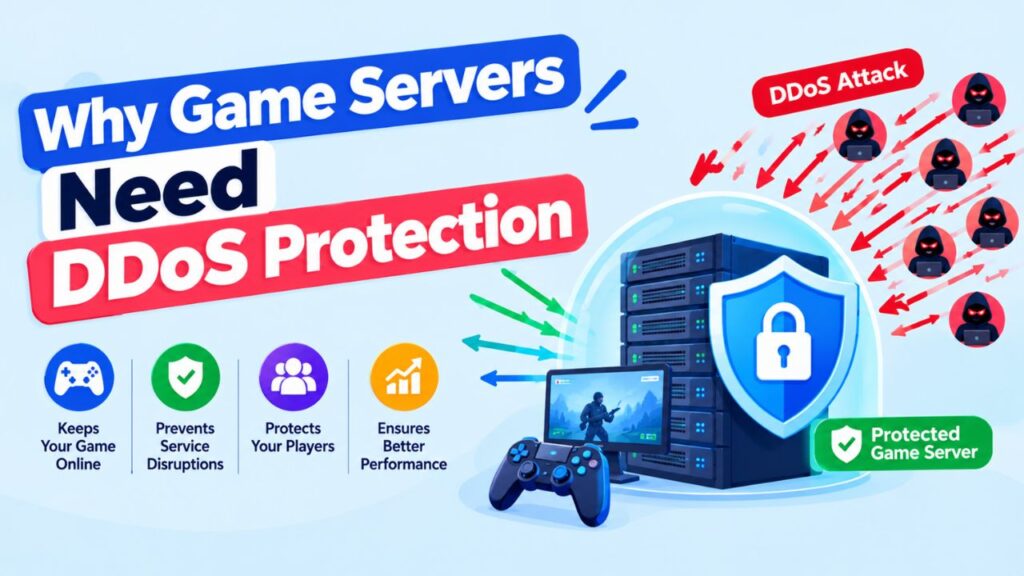
A game server can have powerful hardware and still become unavailable when a DDoS attack overwhelms its network. For multiplayer games, even a short period of packet loss, high latency, or disconnection can affect the entire player experience.
DDoS protection helps reduce the impact of malicious traffic before it overwhelms the game server or its network connection. This is especially important when you run a public server that stays online for long periods.
In this guide, you will learn why game servers are targeted, what problems DDoS attacks can cause, which servers need protection, and what to consider when choosing protected game hosting.
Why Are Game Servers Targeted by DDoS Attacks?
Game servers are attractive targets because they are designed to remain publicly accessible so players can connect to them.
A public server may expose an IP address or other network services that attackers can target. Popular communities can also become targets because taking the server offline directly affects a large number of players.
Common reasons a game server may be targeted include:
- Competitive disputes
- Rival communities
- Popular public servers
- High profile gaming communities
- Publicly exposed server infrastructure
- Attempts to disrupt online events
- Harassment or retaliation
Not every server will face a DDoS attack, but public and competitive servers generally have a higher exposure than a private server used by a few friends.
What Problems Can a DDoS Attack Cause?
The impact depends on the attack type, size, duration, and the network infrastructure protecting the server.
| Problem | What Players May Experience |
| High latency | Delayed game actions |
| Packet loss | Missing or delayed network packets |
| Disconnects | Players get removed from the server |
| Timeouts | Server stops responding normally |
| Network saturation | Legitimate traffic struggles to get through |
| Downtime | Players cannot connect |
| Unstable gameplay | Frequent interruptions and connection issues |
High Ping
When malicious traffic creates network congestion, players may suddenly see much higher latency.
This can make real time gameplay difficult, particularly in competitive games where timing matters.
Packet Loss
Packet loss occurs when network packets fail to reach their destination properly.
For multiplayer games, packet loss can result in:
- Rubber banding
- Delayed actions
- Missing updates
- Sudden disconnects
- Unstable gameplay
Player Disconnects
If the attack seriously affects the network path, connected players may lose their connection to the server.
New players may also be unable to join while the attack continues.
Server Downtime
A severe attack can make the game server unreachable.
For a public community, extended downtime can mean lost players, interrupted events, and a poor overall experience.
How Does DDoS Protection Help a Game Server?
DDoS protection is designed to separate legitimate player traffic from unwanted traffic before the latter can overwhelm the protected infrastructure.
The basic idea is:
Incoming Traffic → Detection → Filtering → Mitigation → Legitimate Traffic → Server
Depending on the provider, mitigation may involve traffic filtering, rate limiting, traffic scrubbing, or other network level controls.
The exact method varies between hosting providers, so the term DDoS protected should not be treated as a complete technical specification.
Main Benefits
- Helps maintain server availability
- Reduces attack related network congestion
- Protects network capacity
- Helps reduce unexpected disconnects
- Keeps legitimate traffic flowing
- Reduces the risk of prolonged downtime
DDoS protection is mainly about availability and network security. It does not automatically improve CPU performance, RAM availability, server configuration, or normal network latency.
Which Game Servers Need DDoS Protection?
The need for protection depends on how the server is used and how much exposure it has.
| Server Type | Need for DDoS Protection |
| Private server for friends | Low to moderate |
| Small public server | Moderate |
| Large public community | High |
| Competitive server | High |
| Popular gaming network | Very high |
| Public event server | High |
Private Game Servers
A small private server used by a few trusted players may have a lower risk.
You may still choose protected hosting, but the cost benefit calculation can be different from that of a large public community.
Public Game Servers
Public servers are more exposed because anyone can potentially discover and connect to them.
If your server has a growing player base, DDoS protection becomes more valuable.
Competitive Servers
Competitive communities can be more sensitive to network disruption.
A sudden attack can interrupt matches, disconnect players, and affect tournaments or ranked gameplay.
Large Gaming Networks
If you operate multiple game servers or a large gaming community, downtime can affect many players at once.
In this situation, network level DDoS protection should be considered an important part of the hosting infrastructure rather than an optional extra.
What Should You Check Before Choosing DDoS Protected Hosting?
Don’t select a provider simply because it advertises “DDoS protection.”
Check the actual protection offered with the plan.
| Factor | What to Check |
| Mitigation capacity | Gbps/Tbps capacity and infrastructure |
| UDP protection | Important for many multiplayer games |
| L3/L4 protection | Network and transport layer coverage |
| Automatic mitigation | Response without manual intervention |
| Network quality | Latency, routing and packet loss |
| Protection limits | Attack size or traffic restrictions |
| Server location | Distance from your players |
| Support | Assistance during attacks |
Check UDP Support
Many real time multiplayer games use UDP for some network communication.
If your game depends on UDP, confirm that the provider’s DDoS protection covers UDP traffic.
Don’t Focus Only on Tbps
A provider may advertise 1 Tbps, 5 Tbps, or even more protection capacity.
A large number can sound impressive, but it does not tell you everything about the mitigation system.
Also consider:
- Detection speed
- Filtering quality
- Network architecture
- Routing
- Automatic mitigation
- Provider reliability
- Protection limits
Check the Network, Not Just the Protection
A DDoS protected server can still perform poorly because of a bad network route or distant server location.
Choose a location close to your main player base and consider normal latency and packet loss alongside DDoS protection.
Is DDoS Protection Worth It for a Game Server?
For a small private server, paying extra for advanced protection may not always be necessary.
For a public server that needs to remain online, the value can be much higher.
DDoS protection is particularly worth considering when:
- Your server is publicly accessible
- You have a growing player community
- Downtime affects your revenue or reputation
- You run competitive matches
- You host gaming events
- You operate multiple game servers
- Your server needs high availability
The decision ultimately depends on the server’s exposure, player base, budget, and tolerance for downtime.
FAQs
Does every game server need DDoS protection?
No. A small private server has a different risk profile from a large public gaming network. Public and competitive servers generally have a stronger reason to use DDoS protected hosting.
Can DDoS protection prevent game server lag?
It can help with lag caused by a DDoS attack, but it does not fix normal performance problems such as CPU limitations, insufficient RAM, poor routing, or packet loss.
Can a DDoS attack disconnect all players?
A serious attack can cause widespread disconnects if it overwhelms the server’s network or surrounding infrastructure. The actual impact depends on the attack and available mitigation.
Is DDoS protection important for Minecraft servers?
It can be useful for public Minecraft servers, particularly larger communities. The importance depends on the server’s visibility, player base, and risk of network attacks.
Is DDoS protection important for VPS game hosting?
Yes, if the VPS is hosting a publicly accessible game server. However, check whether the provider protects the actual game traffic and protocols you use.
Does DDoS protection improve ping?
Not directly. Its main purpose is to mitigate malicious traffic. Normal ping depends on factors such as server location, routing, network quality, and player distance.
Conclusion
Game servers need DDoS protection because network attacks can cause high latency, packet loss, player disconnects, and complete downtime.
The need is especially strong for public, competitive, popular, and continuously online servers where even a short outage can affect many players.
When choosing hosting, look beyond the advertised DDoS capacity. Check UDP support, L3/L4 coverage, automatic mitigation, network quality, protection limits, server location, and provider support.
For a server where uptime matters, DDoS protection can be an important part of a reliable game hosting setup.
Pingback: How to Protect a Game Server From DDoS (Step-by-Step Guide)