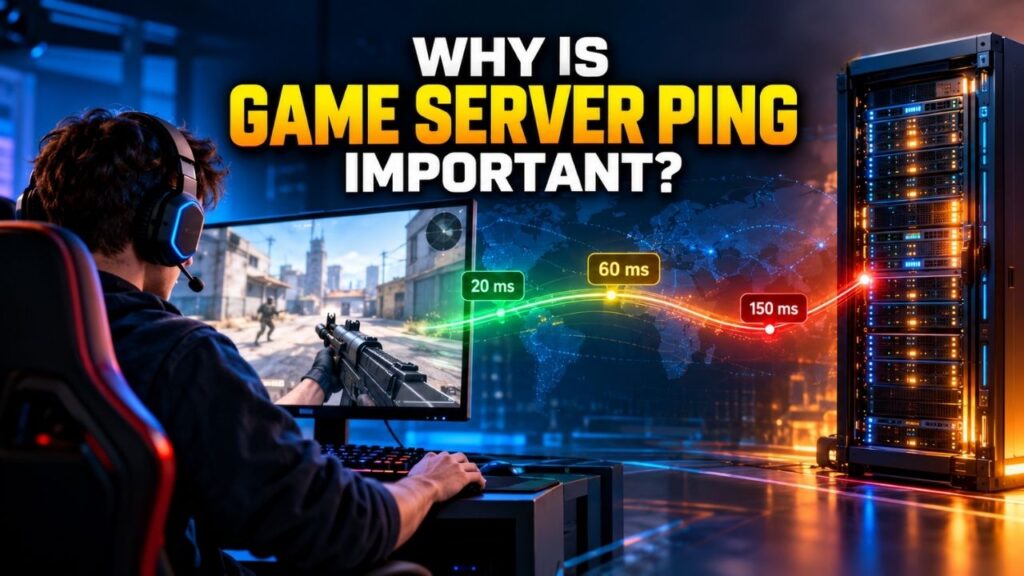
When you play an online multiplayer game, your actions do not happen only on your computer. They have to reach the game server, which processes the shared game state and communicates the result back to your device.
That is why game server ping matters. It gives you an idea of how much network delay exists between your game client and the server. A lower and more consistent ping generally means your actions can be communicated with less network delay.
This becomes especially noticeable in fast multiplayer games, where a small delay can affect movement, aiming, timing, and other actions that depend on quick communication with the server.
Ping Affects How Quickly Actions Reach the Server
Every online multiplayer action involves communication between your device and the game server.
You press a button, move your character, fire a weapon, or interact with something in the game. The relevant information has to travel to the server, where the game can process it as part of the shared session.
When the network response takes longer, there can be a larger gap between your input and what you see happen in the multiplayer environment.
For example, imagine you are playing a competitive shooter and press the button to fire. With a lower network delay, the communication with the server generally takes less time. With higher delay, the result may feel less immediate.
Ping does not control the game itself, but it is one part of the communication path between you and the server.
Low and High Ping Feel Different
The difference becomes easier to understand when you look at how ping can affect responsiveness.
| Ping | General Effect |
| Low | Less network delay between the client and server |
| Higher | More delay can occur during communication |
| Unstable | Response time can change during gameplay |
These are general descriptions rather than fixed gaming standards. A particular ping value does not guarantee the same experience in every game.
The type of game also matters. A slower paced game may be less sensitive to network delay than a competitive game where players rely on precise timing.
So, when someone says a game has “good ping,” they are generally referring to a connection with relatively low and stable network delay for that particular gaming situation.
Why Ping Matters in Competitive Games
Ping becomes particularly important in competitive multiplayer games because many actions happen in real time.
Consider a fast shooter. Two players may see each other at almost the same moment, but their devices still need to communicate with the game server. The timing of that communication can influence when actions are received and reflected in the shared game state.
The same idea applies to:
- Shooting and aiming
- Character movement
- Dodging attacks
- Timing abilities
- Player to-player interactions
- Other time sensitive actions
A higher ping does not automatically mean that a player will lose. It simply means there is more network delay in communication with the server.
For competitive games where reactions and timing matter, that delay can become more noticeable.
Ping Can Affect Multiplayer Responsiveness
Responsiveness is one of the easiest ways to understand why ping matters.
Suppose you move your character and the game responds immediately. The controls feel connected to what is happening on screen.
Now imagine the communication with the server takes longer. You may notice a delay between an input and the corresponding result.
This can be especially noticeable when:
- Players are moving quickly
- Combat happens at close range
- Actions need precise timing
- Several players interact at the same time
- The game depends heavily on server side processing
The effect depends on the game’s networking model and how it handles player input, prediction, and server updates. So ping should not be treated as the only factor that determines responsiveness.
Stable Ping Matters Too
A consistently moderate ping can sometimes feel better than a connection that repeatedly jumps between low and high values.
For example, imagine your ping normally stays around 40 ms but suddenly rises to 150 ms, then drops again. That change can create an inconsistent experience even though the average value might not look extreme.
These sudden changes are commonly called ping spikes.
During a spike, communication with the server takes longer than it normally does. In a fast multiplayer game, you may notice delayed actions, temporary movement irregularities, or other changes in responsiveness.
This is why looking only at the lowest ping number can be misleading. Consistency also matters.
Ping Is Only One Part of Game Performance
Ping is important, but it does not tell you everything about a multiplayer game’s performance.
For example, FPS describes how many frames your device renders per second. A player can have high FPS and still experience high network delay.
Similarly, bandwidth and ping are different measurements. A connection can have substantial bandwidth while still experiencing network latency caused by distance, routing, congestion, or other conditions.
The game server itself also has its own workload and performance characteristics.
So, if a multiplayer game feels slow or unstable, ping is one thing to consider, but it should not automatically be blamed for every problem.
FAQs
What happens when game server ping is high?
Higher ping means there is more network delay between your device and the game server. In a real time multiplayer game, this can make actions feel less immediate.
Is low ping important for every game?
Low ping can be useful for any online multiplayer game, but its practical importance depends on the type of game. Fast competitive games are generally more sensitive to network delay than slower paced games.
Is stable ping better than fluctuating ping?
A stable connection can provide a more consistent experience because the communication delay does not keep changing significantly during gameplay.
Does ping affect competitive gaming?
Yes. Network delay can matter more in competitive games where players depend on quick reactions, precise timing, and rapid communication with the server.
Can high ping cause delayed actions?
High ping can contribute to a delay between your input and the server’s communication with your game client. The exact effect depends on how the particular game handles networking.
Does ping affect FPS?
No. Ping and FPS measure different things. Ping relates to network communication, while FPS measures how many frames your device renders per second.
Conclusion
Game server ping is important because multiplayer games depend on communication between your device and the server. The more network delay involved, the longer it can take for information to travel between both sides.
This matters most when gameplay depends on quick reactions and precise timing. A lower and stable ping generally provides a more consistent connection between your actions and the shared game environment.
However, ping is only one part of the experience. FPS, bandwidth, network stability, routing, and server side performance can also influence how a multiplayer game feels.
In simple terms, game server ping matters because it helps determine how quickly your actions and game data can travel between your device and the server.